
Natal chart explained: a plain guide to your birth chart
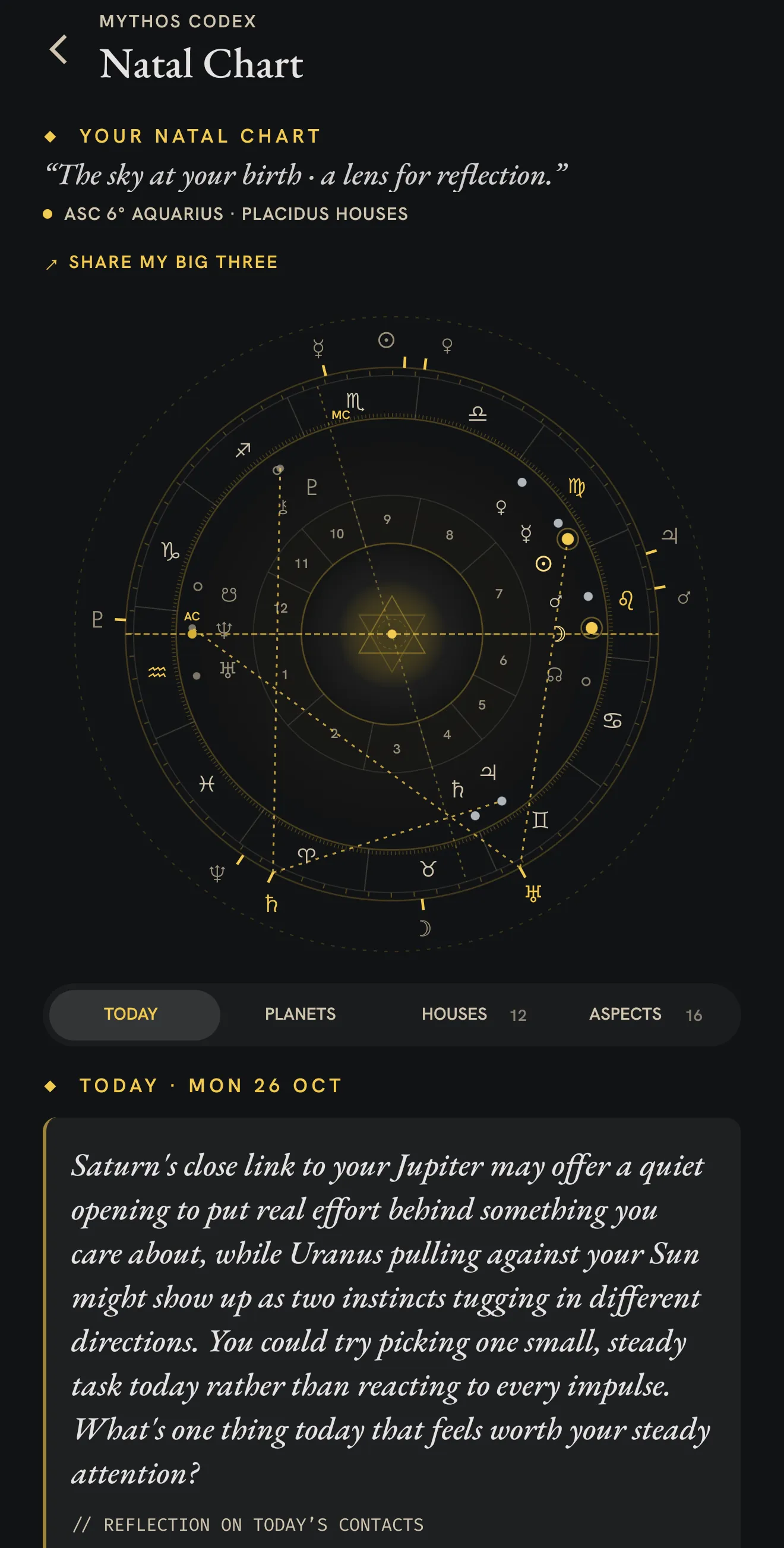
A natal chart, or birth chart, is a map of the sky at the moment you were born, drawn from the place you were born. It shows where the Sun, the Moon and the planets were, and how they sat against the horizon. Astrologers read it as a picture of the patterns you might notice in yourself. This guide explains the main parts in plain words.
What you need
To draw a natal chart you need three things:
- Your date of birth. This sets where the Sun and planets were.
- Your time of birth. The Moon moves about 13 degrees a day, and the rising sign changes roughly every two hours, so the time matters a great deal.
- Your place of birth. The horizon depends on where you were on Earth.
If you do not know your birth time, a chart can still be drawn, but the rising sign and the houses will be uncertain. In Mythos Journal a chart without a time is marked as approximate, and the parts that depend on the time are left out rather than guessed.
How a chart is worked out
The positions are calculated, not invented. Planet positions for any moment are known from astronomy. Mythos Journal works them out with our own software, built on the open source Astronomy Engine library, from the date, time and place you give. The meanings shown beside them come from notes that cite the astrological tradition.
The big three
Most people start with three placements.
- The Sun sign is the sign most people mean when they say “I’m a Libra”. It is read as your core drive: what you are here to grow into.
- The Moon sign is read as your emotional nature: what you need to feel safe, and how you react before you think.
- The rising sign, or Ascendant, is the sign coming up over the eastern horizon at your birth. It is read as your manner: the way you meet the world and the first impression you give.
Two people with the same Sun sign can feel very different, because their Moon and rising signs differ. That is one reason a full chart says more than a horoscope column.
The planets
Each planet is read as a different part of you. In brief, following the tradition:
| Planet | Read as |
|---|---|
| Mercury | How you think and speak |
| Venus | What you love and value |
| Mars | How you act and assert yourself |
| Jupiter | Where you grow and find meaning |
| Saturn | Where you build structure and meet limits |
| Uranus, Neptune, Pluto | Slower, generational themes of change, ideals and depth |
The sign a planet sits in is read as its style, and the house as the area of life where it shows up.
The houses
The chart is divided into twelve houses, counted round from the rising sign. Each house is read as an area of life: the self, resources, communication, home, creativity, daily work, partnership, shared resources, learning, vocation, friendship and the inner life. Mythos Journal uses the Placidus house system, one of the most common, and switches to a simpler method at very high latitudes where Placidus cannot be drawn.
Aspects
Aspects are the angles between planets. A conjunction (planets together), a trine (120 degrees apart) or a sextile (60 degrees) is often read as ease; a square (90 degrees) or an opposition (180 degrees) as tension. Tension is not bad. In most readings it is where the energy and the growth come from.
How to read your own chart
Start small. Pick one placement a week and ask whether it fits, partly fits, or does not fit at all. Write down what you notice. A chart is most useful as a set of questions, not a set of answers.
Read your chart the way you would read a mirror: to notice, not to obey.
If you want to see how long cycles move across your chart over the years, read about the Saturn return. For two charts read side by side, see synastry. In the app, your chart lives under Profile, with every placement explained in plain words.
Sources: Ptolemy, Tetrabiblos; William Lilly, Christian Astrology (1647); Astronomy Engine (open source) for positions.